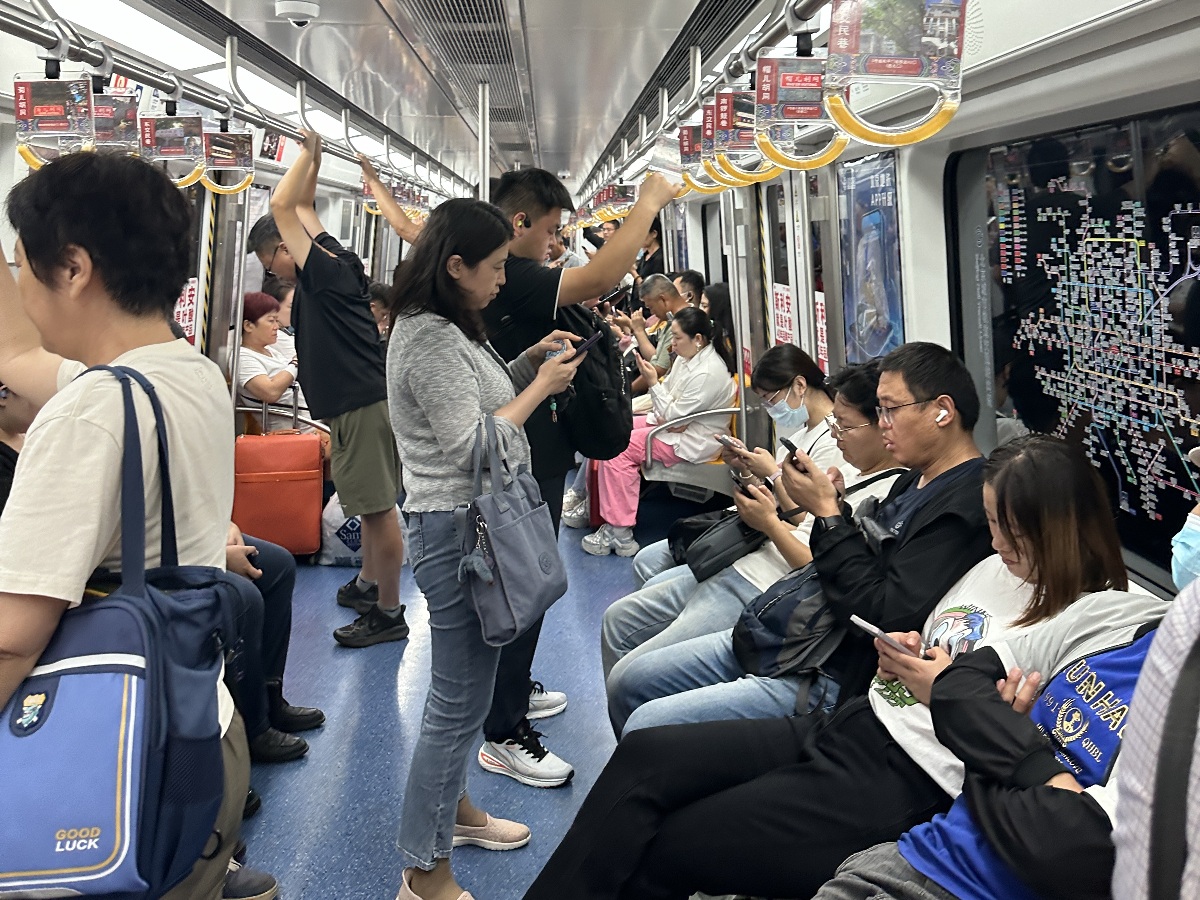
Is the underground in China easy to use? Absolutely — once you know what you’re doing!
Using underground trains in a new country can be a challenge.
We’ve had our fair share of underground adventures over the years. Once, my husband nearly got into a women-only carriage — thankfully, I stopped him at the last minute. The shocked looks on the women’s faces told us that he probably wouldn’t have been very welcome!
On another occasion, in New York, so many stations were closed for repairs that we eventually gave up and decided to walk.
So, when we first started using the underground in China, we weren’t quite sure what to expect.
We have now visited China several times, and we find the underground one of the easiest and cheapest ways to get around the cities. There have been moments when we have stood in front of a ticket machine, scratching our heads and wondering what on earth was going on. But eventually, we worked it out.
Taxis are relatively cheap in China, but they can get stuck in traffic. And when it is incredibly hot outside, sitting in an air-conditioned train is much more appealing than sitting in a taxi that isn’t moving.
Sometimes, after walking for 10 minutes through an underground station, I begin to wonder whether I will ever actually reach a train or whether I have accidentally joined an underground walking route instead!
But despite the occasional confusion, we now happily use the underground whenever we can.
So, if you’re visiting China and wondering whether you should use the metro or subway, my answer is yes.
Is the underground easy to use in China?
Although metros and subways are generally straightforward to use, like everything else, they are only easy when you know how.
Underground railway lines are referred to as the metro in Shanghai and Xi’an, while in Beijing they are known as the subway.
Whatever they are called, they all work roughly the same way.
There are some differences depending on which city you are in and how old the carriages are, but once you understand the basics, you should be able to use the system without too much trouble.
Download a China subway map
Before you travel, I recommend downloading a subway map for each city you are visiting.
You could try MetroMan China or Mapway.
You can enter the station you are starting from and your final destination, and the app will show you the route and how long it should take.
Each railway line has a number and a colour. It is helpful to make a note of the final destination of the line you need because this tells you which direction the train is travelling in.
This is usually shown on the platform signs, but I try to double-check before getting on the train.
It is surprisingly easy to get on the wrong train!
How to find an underground station entrance
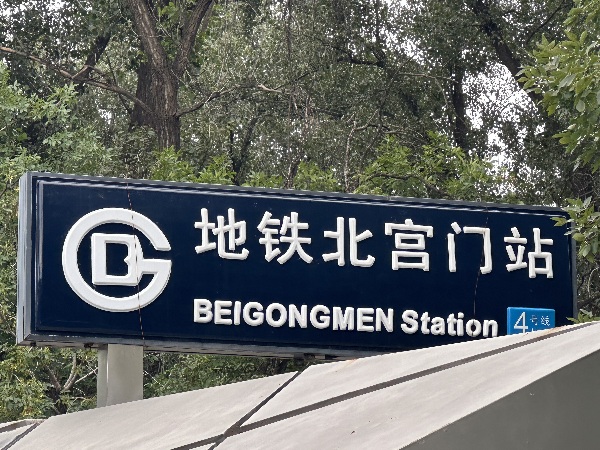
This sounds obvious, but finding the entrance can sometimes be the first challenge.
Underground signs vary from city to city, so it is worth looking up what they look like before you arrive.
Normally, you will find a sign above some steps leading underground. However, the entrance could also be above a doorway in an office block or a large shop.
The first underground station entrance we went to in China was inside a multi-storey car park.
They do like to hide the entrances sometimes!
If you know what the sign looks like, you will have more confidence that you are going in the right direction and not accidentally walking into a private building.
Station entrances are often at crossroads, but not always.
And remember that a station can have several entrances, sometimes quite a long way apart.
Security checks at Chinese underground stations
Before you can reach the trains, you will need to pass through a quick security check.
Don’t worry — it is usually very straightforward and fast.
Walk to the security gate, place your bags on the conveyor belt and collect them after they have passed through the scanner.
Then you can continue into the station.
How to buy underground tickets in China
I was told that you could buy tickets from a member of staff, but at some stations we never saw any ticket staff, only security personnel.
It is probably better for us to buy tickets from a machine anyway. That way, we don’t have to worry about our terrible pronunciation of Chinese place names!
The ticket machines are usually obvious, but in some of the larger stations we have had to search for them.
Using the ticket machine
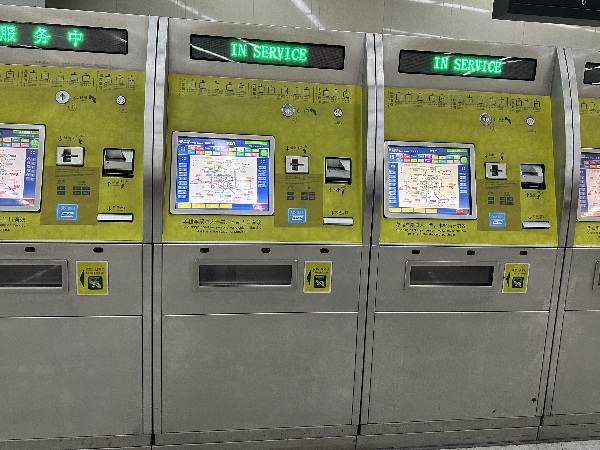
The machines are fairly straightforward once you know what to do.
- Select English. This is often found at the bottom left or top right of the screen. Even if you can’t read the buttons, try selecting the one on its own at the top or bottom and see if the language changes to English.
- Select the train line for your destination.
- Select your final station.
- Select how many tickets you need.
- Pay. We always use Alipay, but you can also pay with cash.
- Collect your ticket.
The tickets are incredibly cheap compared with European trains. Today, our two-hour journey cost just £1 ($1.35).
Occasionally, we found that we couldn’t use Alipay on the standard ticket machine. We could have paid with cash, but we usually found another machine nearby with a slightly different setup that did accept Alipay.
So, if your first attempt doesn’t work, don’t panic. Look around for another machine.
Taking the airport express train
Some stations have an express train to the airport. These will usually have another machine specifically for airport express tickets.
These tickets have a set price, so you don’t need to enter your destination.
You might be able to take a slower and cheaper train to the airport, but we nearly got caught out doing this once.
The train line had alternative routes, and we got on a train that didn’t stop at the airport.
Fortunately, we had enough time to realise our mistake and correct it.
If you are travelling to the airport, always double-check that the train you are boarding actually goes there.
Getting through the ticket barrier
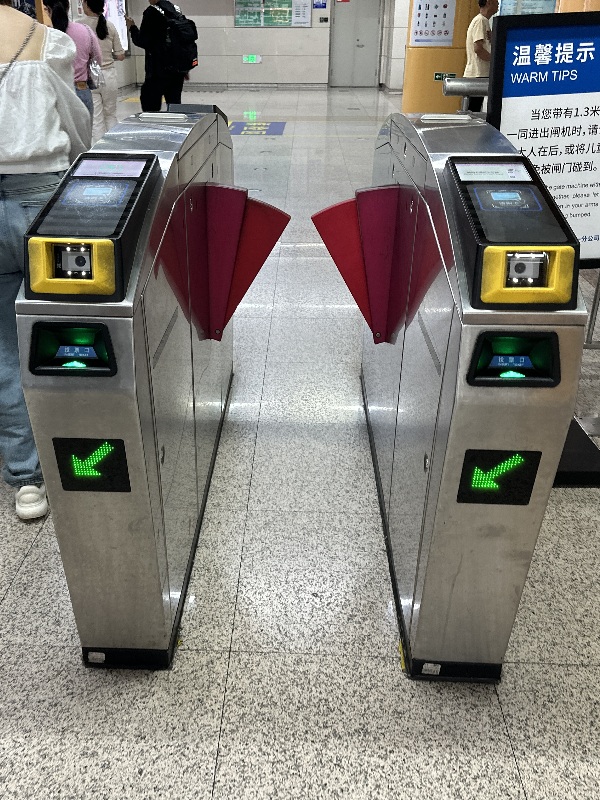
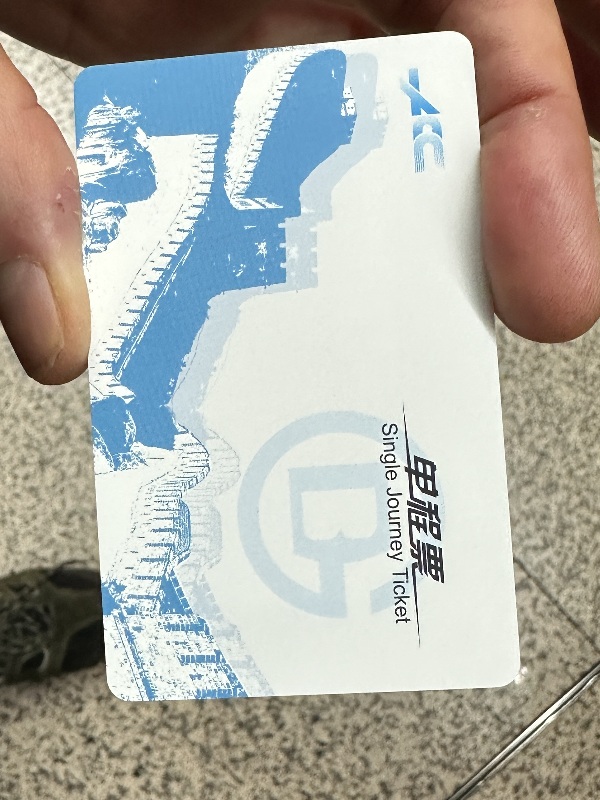
When you reach the ticket barrier, scan your ticket at the top of the machine.
Then follow the signs for the line you want and check which platform you need.
Look for the final destination of the line to make sure you are going in the right direction.
There are signs in English, which makes things much easier.
The trains arrive very quickly, and the display tells you when the next train will depart. You might not be able to read the Chinese characters, but you can at least watch the numbers counting down.
What are the trains like?
The doors shut very quickly.
I once saw one person get separated from the rest of their group, so hold on tightly to any children you have with you.
If you can’t get on quickly because the train is full, it may be better to wait for the next one.
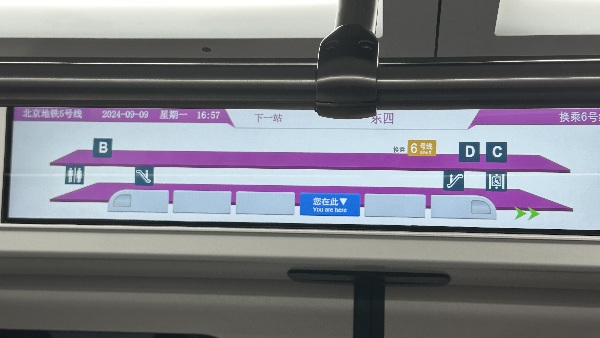
Inside the train, there are usually maps showing the stations along the route. A green light shows how far along the line you are.
Sometimes this information is displayed on a screen, either on the wall or in the centre of the carriage. It is usually written in both Chinese and English.
There are also announcements in Chinese and English, although these can be harder to understand, especially when the train is crowded and noisy.
The doors open automatically. Often, a green light or a picture of an open door appears on a screen to show which side of the carriage will open.
Are China’s underground trains clean?
Yes!
The trains we have used have generally been spotless.
You are not allowed to eat or drink on them, and the seats are plastic. They are perfectly fine for short journeys, but today, during our two-hour subway journey, those seats felt very hard after a while!
Changing underground lines
If you need to change lines, when you arrive at the platform, follow the signs for your new line, not the exit.
Don’t just follow everyone else!
It sounds obvious, but when you are tired, hot and surrounded by signs in another language, it is surprisingly easy to follow the crowd.
If you accidentally go through the exit barrier, you may have to buy a new ticket for the rest of your journey.
How to find the right station exit
This is one of my biggest tips for using the underground in China.
Find out which exit you need before you arrive.
Each station has multiple numbered exit gates.
And these aren’t necessarily close together.
The exits can be a 10-minute walk from each other and may be on completely different sides of major roads.
Coming out of the wrong exit can therefore leave you with a much longer walk than you expected.
It is also incredibly confusing to come out of a station and have absolutely no idea where you are!
Some attractions will tell you which station exit is closest in their directions.
Another way to find the station exit number is to use the Chinese map service Baidu Maps.
Baidu can be difficult to use at first if you don’t read Chinese, but Google Maps is not very accurate in China. So I had to persevere.
For famous attractions, you can often type the name in English and Baidu will find it. You may then need to zoom in or out before the station exit number appears.
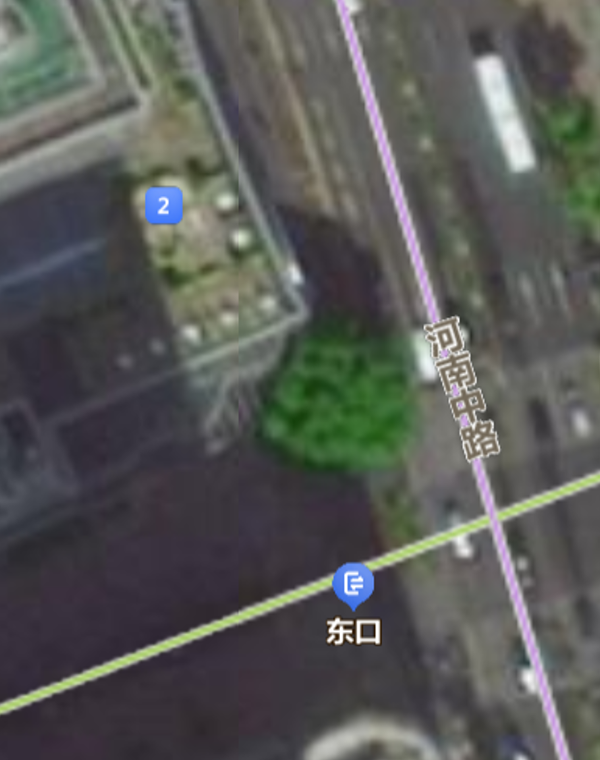
It is worth doing this before your journey because the difference between two exits can be surprisingly large.
Are there day passes for the underground in China?
There are one-day and three-day passes available.
We chose not to use them because we were staying in the centre of the cities and weren’t travelling very far.
With normal tickets, you are charged according to the distance you travel. We often travelled less than 6 km, which cost less than 25p ($0.34).
The day passes might be worth considering if you are staying on the outskirts of the city and plan to make lots of journeys.
The passes are activated on the first day you use them.
Using the underground during rush hour
We had been advised to avoid the subway during rush hour, which is generally from 7:30 am to 9:00 am and 5:30 pm to 7:00 pm.
I think it is particularly good advice if you have young children, are elderly, or are using China’s underground system for the first time.
We often travelled during rush hour.
When the carriages looked completely full, we simply walked further down the platform and waited for the next train. At that time of day, the wait was usually less than five minutes.
We were rarely able to get a seat during rush hour.
Even when we were the first people to get on and could see empty seats in front of us, someone would suddenly dart around us and grab it.
I used to be quite good at musical chairs when I was a child — the game where you have to grab a seat when the music stops.
If you want a seat during rush hour, I suggest you practise this game beforehand.
I think China should make grabbing a seat an Olympic sport. They would definitely win!
Getting off during rush hour
When you are approaching your station, make your way towards the doors and be prepared to squeeze your way through the people getting onto the train.
Sometimes people wait until everyone has got off before boarding, but often they don’t.
You have to be prepared to be very pushy sometimes. Although some cities are better than others.
Can you take suitcases on China’s underground?
Yes, but I would think carefully about whether it is the best option.
On one trip, we flew into Shanghai early in the morning and immediately hit rush hour.
We had very small suitcases and managed to get off the train despite the crowds. However, if we had wanted to get off at an earlier station, I doubt we would have managed it because the carriage was even more crowded then.
Everyone on the trains seems to be either looking at their phones or asleep.
Even people standing up have their eyes closed!
So they are not necessarily going to notice that you are trying to squeeze past them.
If you have a large suitcase, I would avoid the underground, especially at peak times.
There are rules about the size and weight of suitcases allowed on trains, although they are rarely enforced. However, this might be one of those occasions when taking a taxi is a much better option.
You also need to be able to carry your suitcase because there are often steps.
Once inside the station, there are usually escalators or lifts that you can use. However, getting into the station in the first place often involves a flight of stairs.
At our first hotel, we discovered that the nearest station exit had a long flight of stairs. However, another exit, just three minutes further along the road, had an escalator.
As we had to walk past this exit anyway when leaving the station, we used it whenever we had our suitcases.
What if I use a wheelchair or have mobility problems
If you have mobility problems or find stairs difficult, I would seriously consider using a taxi instead.
I did see a wheelchair lift on one flight of stairs, but unfortunately, it was locked up.
The tunnels to the stations and those connecting lines can be very long.
The steps are another issue. I frequently came across steps at entrances going up and then immediately down, which seemed pointless until I realised it was probably to stop the rain coming in.
Don’t assume every train goes where you expect
Although the underground system is usually very easy to follow, we have made a few mistakes.
Once in Shanghai, we needed a train line that split into different routes partway through the journey.
In the UK, we usually go to the platform and then choose the correct train when it arrives.
At this particular station in Shanghai, however, we had to go to a different platform with the same number. Who would have thought they would number two platforms the same number!
We only discovered our mistake after travelling several stops in the wrong direction, so we had to backtrack.
We should have checked more carefully before getting on.
On another occasion, we got on a train going in the wrong direction because trains going both ways used the same platform.
We saw a sign with our destination on it when we entered the platform and assumed we were in the right place.
We weren’t.
We also once got on a train that stopped partway along the route and then went back the way we had just come.
There were other people on the train, so at least we weren’t the only ones who hadn’t realised what was happening!
Although China’s underground system is generally very easy to navigate, it is surprisingly easy to make a mistake occasionally.
The good news is that, if you are sightseeing, this usually isn’t a problem.
Just get off at the next station and catch a train back. You don’t need a new ticket.
However, if you are heading to the airport or somewhere else that is time-sensitive, allow plenty of extra time.
Underground travel in China: our top tips
After several trips to China, these are the things I would remember:
- Download a subway map before you travel.
- Make a note of the final destination of your train line.
- Check the direction before getting on.
- Find out which station exit you need before you arrive.
- Don’t be afraid to wait for the next train if the carriage is too crowded.
- Be particularly careful with children during busy periods.
- Avoid rush hour if you have large suitcases.
- Expect plenty of stairs or long walks.
- Keep an eye on your belongings.
- Allow extra time if you are travelling somewhere important.
- Don’t panic if you get on the wrong train. Get off at the next station and go back!
Is China’s underground worth using?
Definitely.
China’s underground railway system is very tourist-friendly and, once you get the hang of it, usually very easy to navigate.
The air-conditioned carriages make the journey comfortable, and the fares are incredibly cheap.
We used the underground even when we didn’t have far to travel because it could be unbearably hot outside. The traffic in the cities can also be terrible, making taxis a much slower option.
After a few journeys, you will probably find yourself zipping around the city without giving it much thought.
Just remember to check your direction, be prepared for a bit of a hike, keep an eye on your belongings and don’t expect to win a seat during rush hour!
And if you do get on the wrong train, don’t worry.
We’ve done it too.
Enjoy your visit to China!
Leave a Reply