
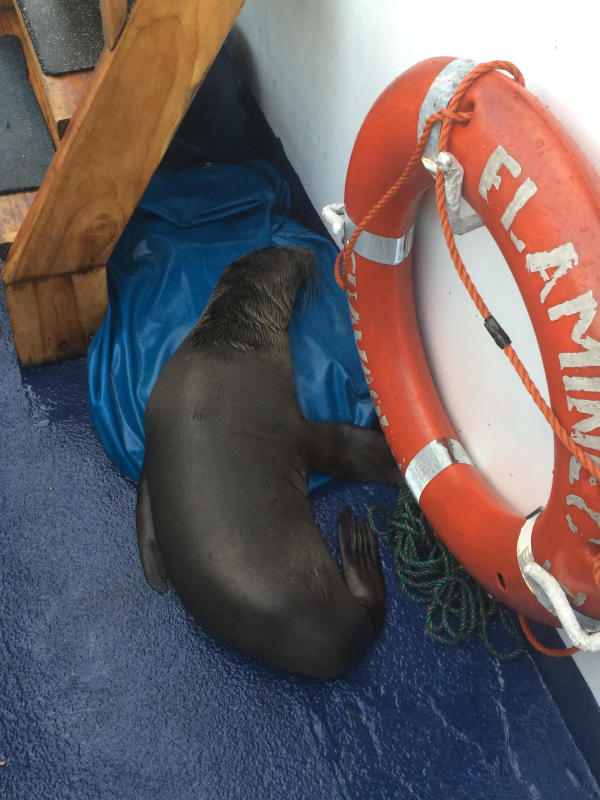
As my husband and I kayaked, a group of sea lions came up to play. They swam alongside our kayak and then under it repeatedly. We tried hard not to hit them accidentally with our oars. I was wondering what we would do if one jumped in. On the first day on our ship, I nearly stood on a sea lion who had sneaked on while we were at port and spent the night sleeping on deck. It looked like these sea lions would be happy to hitch a ride.
The Galapagos Islands are home to many animals that have been protected and have not learned to fear humans. It is wonderful to see what could have happened in a different alternative reality, a world where animals and humans live peacefully together.
Something happened to us in the Galapagos that sparked an interest in animals. We liked animals and had loads of different pets at home, but we never went on holiday to see animals. It was only after seeing the Galapagos Islands that we started to go on safaris.
Why the Galapagos Islands are special
In 1835, Charles Darwin visited the Galapagos Islands. He studied the different species on each island, which helped him form his Theory of Evolution by Natural Selection. The Galapagos Islands then became a place to study evolution without too much interference from man.
Many animals and plants can only be found in the Galapagos Islands, such as the Marine iguana, the only sea-swimming lizard, a flightless cormorant, Darwin’s finches and the Galapagos giant tortoise.
There is also a rich marine life with sea turtles, hammerhead sharks, loads of reef fish, and I can’t forget the sea lions.
The islands were created by volcanic activity; some are old, and some are new and still active and have volcanic eruptions. They illustrate the geological process. The last eruption was on Fernandina Island in March 2024.
In 1978, the Galapagos Islands became the first natural site to be recognised by UNESCO as a World Heritage Site. In 2001, the Marine Reserve was added to it. This means there are strict regulations to help preserve the environment.
Where are they?
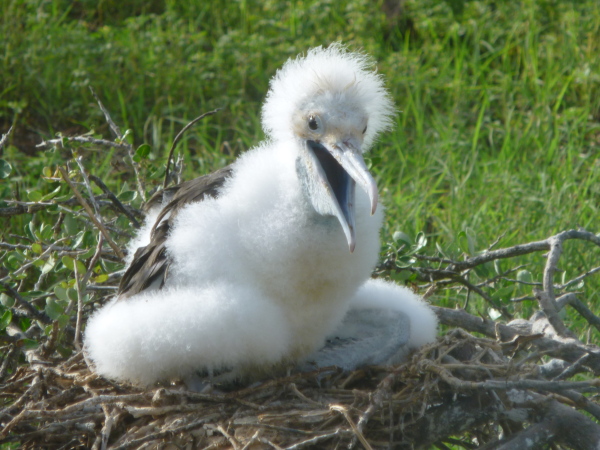
They are remote, which is why they have been fortunate to remain undisturbed for so long. They are about 600 miles (973 km) off the coast of Ecuador.
It is not easy to get to from Europe. We combined it with a visit to Ecuador and Peru.
There are two main airports in Galápagos, one on Baltra Island and the other on San Cristóbal.
The islands
There are 13 major islands and 7 smaller islands.
97% of the land area is protected, and you can only travel there with a tour operator or an authorised boat. The protected area is for the animals. Humans can use the remaining 3% of land.
Strict Rules
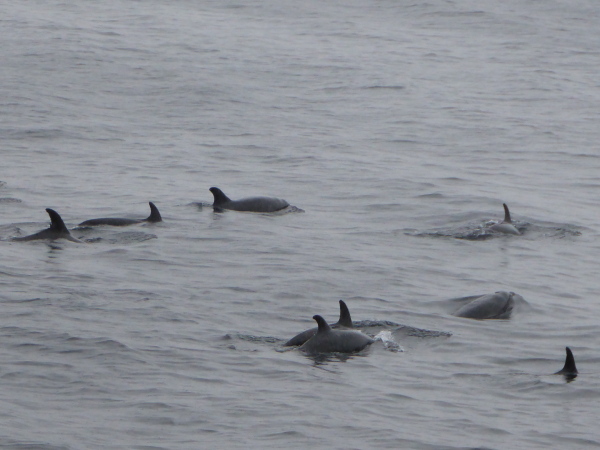
There are rules about how many people can visit an island in the protected area at a time. If you have a larger boat, you might have to wait or be dropped off in a different location.
You must stick to the paths all the time. Only once were we allowed off the path when a bird was nesting in the middle of it, sitting on an egg. If you even step off the path slightly, you will be told off by your guide. They want to protect every plant.
Flash photography is not permitted when taking photos of the wildlife.
You should maintain a distance of at least six feet (two meters) from the wildlife to avoid disturbing them. This rule isn’t easy to follow, as the animals come to you sometimes, and you must back away.
At one time, we landed on an island where some students were waiting to leave. A girl was throwing sticks to a sea lion, which then played with them. It was lovely to see them both enjoying themselves, but the student was soon told off. The rules are that tourists should have as little impact on the wildlife and the islands as possible.
When to go
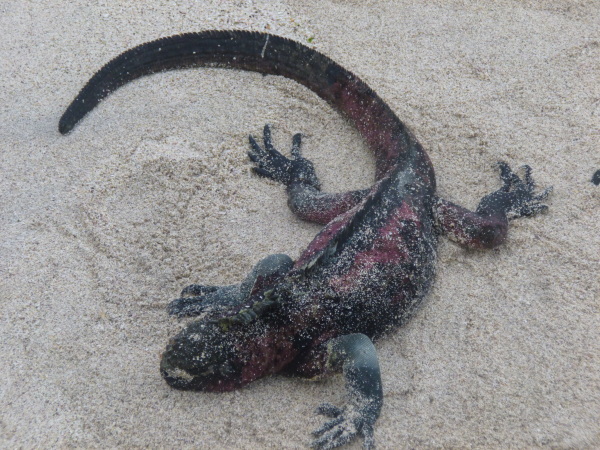
The peak season is mid-June to early September and mid–December to mid-January. If you want to visit during this period, you need to book well in advance.
As the islands are on the equator, the temperature remains relatively stable all year. It is probably best to decide when to go based on the wildlife you are interested in.
Between June and November, the temperature is slightly cooler, averaging around 19-26°C (66-79°F). Misty rain is frequent, and the seas are rougher.
The waters are full of nutrients, which attract the fish and seabirds. You are more likely to see an Albatross and penguins. This is the blue-footed boobies mating season.
Between December and May, the temperature is around 22-30°C (22-30°C). It can be sunny with short periods of rainfall each day. It has higher humidity.
Flowers are blooming, and sea turtles are nesting.
If you suffer from sea sickness, avoid August and September, which are the choppiest months.
We went in May, and there were the occasional short showers, which caught most people out since they hadn’t brought a mac. The showers didn’t last long enough to stop us from doing anything. The sea temperature was fine for snorkelling.
Fees and Forms
The Galapagos Transit Control Card (TCT) is used to track who enters and leaves the Galapagos, as well as their duration of stay. You won’t be allowed to board a plane to the Galapagos Islands without the TCT, and you need to show it as you enter and leave the Galapagos Islands.
You can apply for it online at the official website, and it costs $20 USD. https://siig-cgreg.gobiernogalapagos.gob.ec/tct/emission?lang=en
The National Park entrance is a mandatory charge for all visitors and helps fund conservation efforts and community development projects. The cost is $200 USD for non-Ecuadorian adults and $100 USD for children under 12 years old. This needs to be paid in cash on arrival.
Anyone over 18 years old travelling to the Galapagos Islands needs to fill out a Biosafety Sworn Declaration. This form is to ensure visitors
don’t bring any biological items with them when they visit. You need to declare certain items that you are bringing with you, including hiking boots.
You can complete the form online up to 48 hours before you visit. After you have completed the declaration form, you will receive a QR code, which you will need to show on arrival.
https://declaracion.abgalapagos.gob.ec
Going the cheapest way
Going to the Galapagos Islands can be expensive, but if you want the budget option, then you could stay in a hotel on one of the populated Islands, such as San Cristobal and Santa Cruz, and take day trips to a few of the other islands. This won’t be as good as cruising around the islands, and you will miss out on many of the better experiences.
Going on a cruise
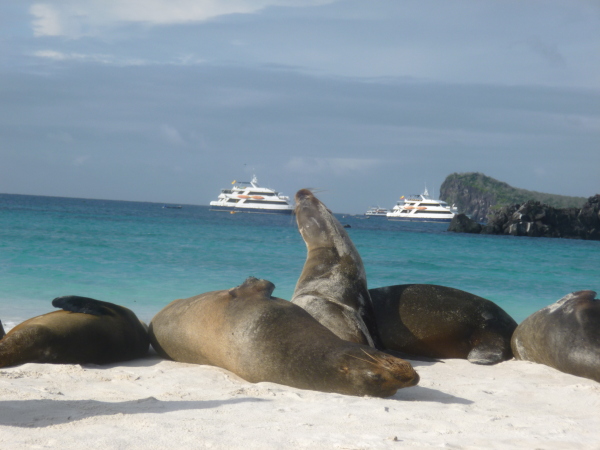
When choosing a cruise, the ship’s size makes a big difference. Small boats with 16 people or fewer allow everyone to disembark at each stop to visit the island. This allows for more wildlife interactions and an intimate experience.
Medium ships have around 50 passengers. These ships will have more facilities aboard. As there is a limit of only 16 visitors per guide, the passengers are divided into groups of 16 passengers, and then the disembarkation is staggered.
Large ships can accommodate up to 100 people and feature additional amenities, including libraries and swimming pools. Again, disembarkation is staggered into groups and will take even longer than the smaller ships.
Activities such as snorkelling or kayaking are offered on many ships; however, there are limited opportunities. On our small boat, we could go every time, but on a larger ship, you must book early and may not get as many opportunities.
If you have a young family or are elderly, you might want to consider a ship like the La Pinta, which is mid-size and has a glass-bottom boat. Generally, the smaller vessels cost more money.
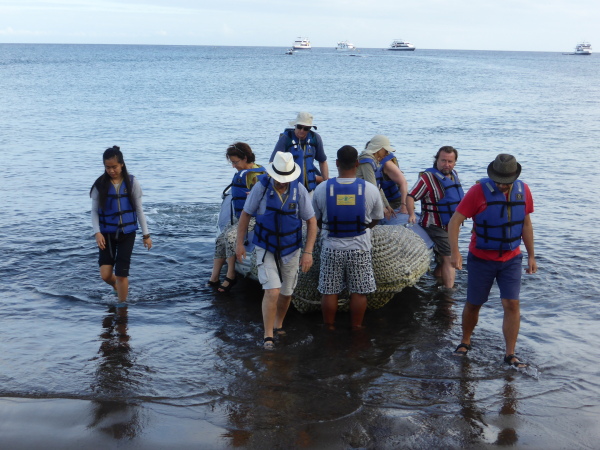
Some of the landings can be wet landings, meaning you get out of the boat into the sea and walk onto the land. You will also probably need to be able to get into a dinghy to get to some islands. If either of these might be a problem for you, then check with the company before you book.
Usually, the ship travels by night to each island, so unlike a cruise on the ocean, you don’t have sea days. Sometimes, if the islands are close, they travel to them during the day.
How long to go for
Most trips are one week or two weeks. This covers a set circuit of the islands.
We stayed for a week, and that was enough for us. Being on a small boat with strangers isn’t really our thing. It’s okay for a while, but we felt more at ease when we could do our own thing. If you are a very social person, consider a two-week cruise where you can pick and choose when to do an activity or rest without missing out on an opportunity.
Which route
Most cruises do a Western/Northern cruise or an Eastern/Southern route. Our ship did both routes, so if you stayed for two weeks, you saw both routes.
However, it can be not very clear, as they are sometimes referred to as the Central/Southern route or the Central/Northern route. This is because many islands overlap regions, and cruise companies are flexible in their labelling for ease of marketing. Just look at the islands they visit rather than the labelling.
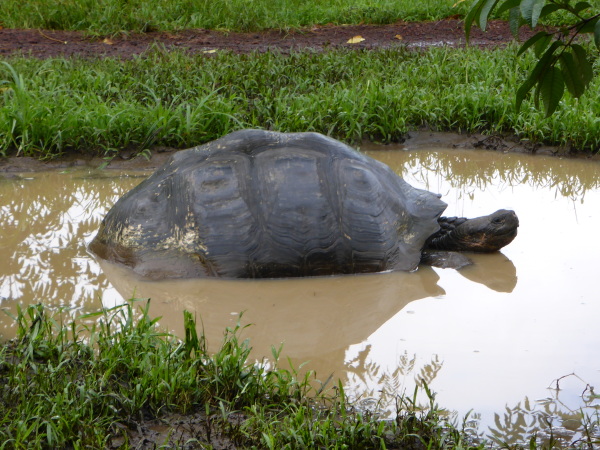
The route with Isabela and Fernandina is best for penguins, marine life and lava. The Giant Tortoises can be seen in Santa Cruz at the Darwin Station. From April to December, head to Espanola if you want to see an Albatross, and Espanola and San Cristobal are good for birdwatching. They are all exciting, so you won’t be disappointed with the route you take unless you have a particular thing you want to see.
Many of the cruises visit the Galápagos Interpretation Centre. It covers the island’s evolution, people, politics, and environmental issues. This stop is usually on the first or last day of a cruise. We stopped on the last day and found it a bit disappointing. Our guide had shared a lot of information with us over the previous week. While I would recommend choosing a cruise date that starts with this exhibit, it’s not a significant consideration.
Summary
Some holidays stay fresh in your memory for good reasons, and our Galapagos holiday was one of them. We had never seen birds so unafraid of people or felt so in tune with animals before. I was really impressed by how the animals were respected, and for once, mankind got it right.
It isn’t all about animals at the Galápagos Islands, although that is a big part of it. We enjoyed lovely meals and felt like millionaires when we sat alone on deck, relishing the sea breeze and watching the distant islands or the birds flying overhead, sometimes landing on the boat.
You could rest if you wanted to, but we took the opportunity to use the kayaks and snorkel. We have never kayaked with playful sea lions before, nor have I told my husband that a shark just swam under us. I think it was harmless. While I was snorkelling, someone told me there was a turtle ahead. I expected a normal turtle about a foot long and was shocked to find the Galapagos Green Sea Turtle. It was four feet long and looked like a moving rock.
If you enjoy nature, this is a place to put at the top of your list. Some animals can be found nowhere else on Earth, like the Marine Iguana, a sea-going lizard that sneezes salt. Or you could see the flightless Cormorant, a rare bird that has forgotten how to fly but is a good swimmer. No one will forget seeing their first blue-footed Booby. It can be found outside of the Galapagos, but these Islands are the easiest place to see the Booby’s elaborate mating dance.
Book a holiday to the Galapagos Islands if you are a bird or animal lover; I am sure you will enjoy it.
Leave a Reply