Recently, we went on a safari in Kenya, which differed from our previous safari in South Africa. It has given us a chance to compare safaris in the two different countries. It was a similar time of year, and we saw similar animals, but the experience was different.
The tent
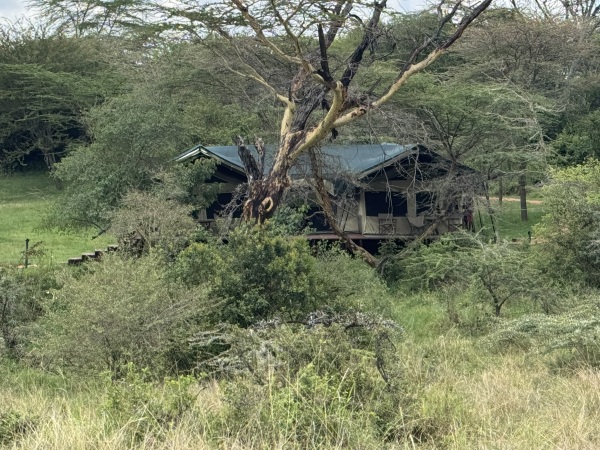
This time, we thought we would be braver and try a tent. We didn’t have many options if we didn’t stay in a tent in Kenya. There are lodges, but for one reason or another, they didn’t suit our needs.
We had a family-size tent that consisted of two halves, each with a double bed and a single bed, and its own shower and toilet.
The whole tent was on a low platform. The beds were regular beds, and the toilet was plumbed in and flushed. So, we weren’t really slumming it. When we told people we were sleeping in a tent on a safari, I am sure they thought we were roughing it more than we really were.
Security
At this bush camp, there were no fences, so the animals could come and go as they pleased. We were told that someone would be on watch at night to ensure our safety. At one of the camps we looked at, they had wooden poles in front of their tents to protect them from elephants, but this one didn’t. Before we arrived, I was slightly concerned about how close the animals would get at night, but once we were there, all my worries disappeared.
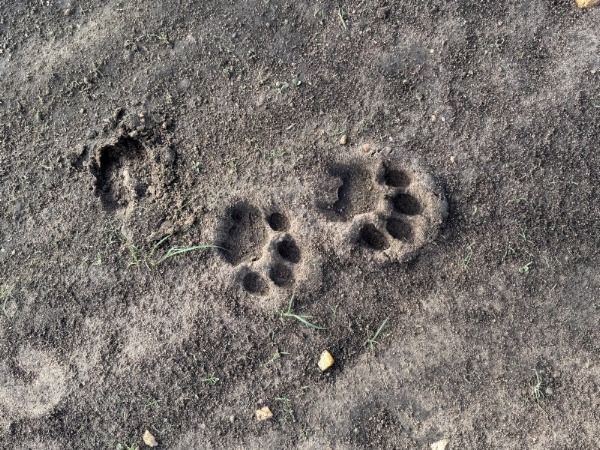
Animals did get very close; we were shown lion footprints just outside our camp. One night, a hippo attempted to steal food from a tree where an elephant was eating; as a result, the elephant chased the hippo. This did sound very loud from inside a tent, but we had complete confidence in our security.
There were a few security guards on duty at night. We were told they protected the camp from the larger, more dangerous animals, but also ensured that the jeeps and other items weren’t stolen. They also protect the guests by ensuring they don’t wander out of the camp, and we were told that they once sorted out a very heated dispute with a married couple, when a woman fled her tent naked. The guests come from all different countries, and some people ignore the advice, thinking it is safe to explore on their own.
There were staff members who would, after dark, show you from your tent to the dining area. They had torches to show you the way. They seemed to appear out of nowhere. We would use the torches they provided to see so we could zip up our tent and padlock it shut to prevent the monkeys from getting in. Before we had even started going down the steps from our balcony, a bright light would appear out of the shadows, and a man would be there to guide and protect us.
At night
Before I went, I imagined I would be hiding under the bedsheets at night, too terrified to sleep, as I listened to the animal noises outside. As it turned out, I went to sleep as soon as my head hit the pillow. My daughter, on the other hand, would listen to the noises and try to guess which animals made them. We were very close to a stream, and she could hear the hippos splashing. She often listened to a lion, but we knew you could hear them from about 5 miles away.
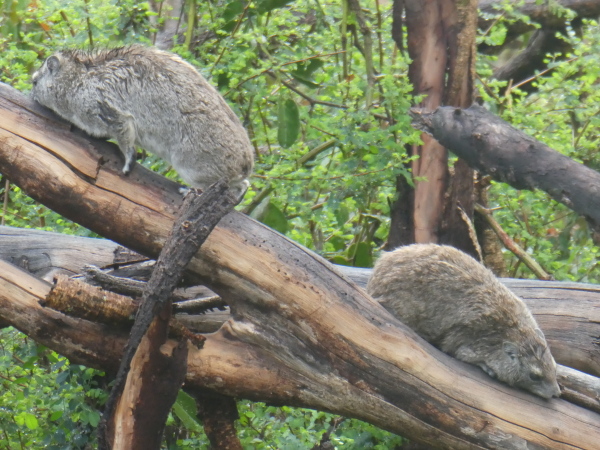
Sometimes, we heard an animal on our tent roof and saw the ceiling move. Often, it was a hyrax, a harmless small animal, or the more annoying monkeys. We also saw a dik-dik (a small deer-like animal) go under our tent base.
Monkeys
One afternoon, a few monkeys decided to play chase around our balcony. It was very noisy, but we realised what was making the din.
We had been warned that the monkeys could get into the tent and mess it up, steal things, and poop in the bed. There were two zips on the door and a padlock. The monkeys could undo the zips but hadn’t learned to undo a padlock yet.
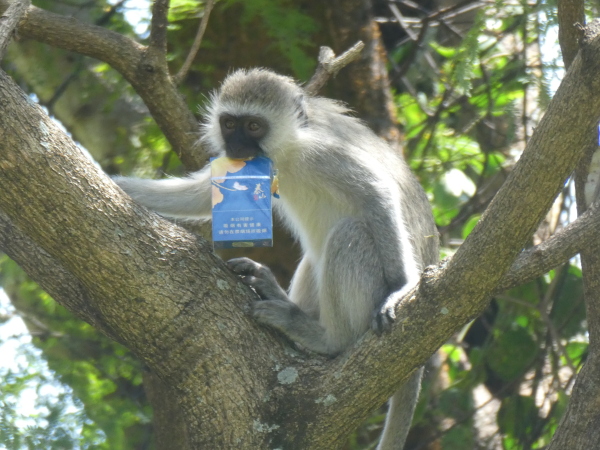
One day, I was taking a photo of a monkey in a tree and realised he was chewing on a box-like thing. As I got closer, the monkey dropped the box in front of me and ran off. It was a Chinese cigarette packet, and lots of cigarettes had been chewed and then dropped to the ground.
As a newly arrived Chinese group had arrived at the camp, it was easy to identify where the monkey had obtained the cigarettes. A staff member went to check if a room had been trashed. As I didn’t hear any more, I presume he had just left the packet on a table outside his tent.
There were loads of monkeys at our South Africa camp, but it is much easier just to shut a sliding door, then do up zips and padlocks.
.
The view
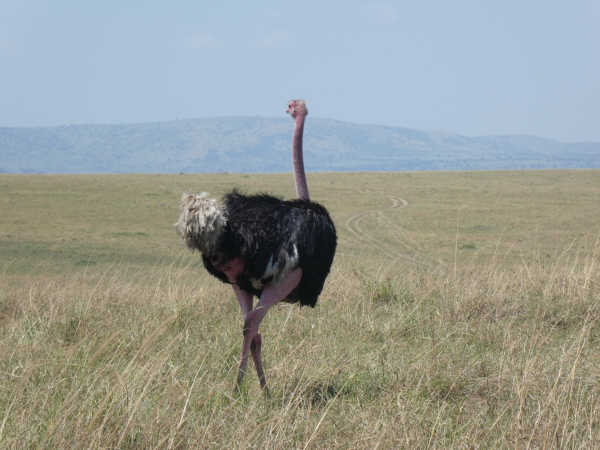
When we sat on the balcony waiting for lunch, I was a little disappointed. At our South African camp, we had a water hole near our balcony, where we could sit and watch the animals come to drink. However, here, there were just bushes and trees. We didn’t have a great view to watch in our relaxing hours.
It turned out there was water here, but I couldn’t see the stream because of the undergrowth. I thought even if a hippo was in the water, I couldn’t see it. I didn’t realise we were so close that we would hear them.
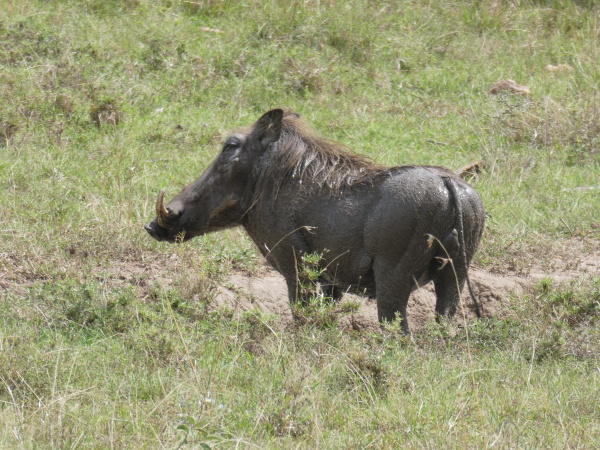
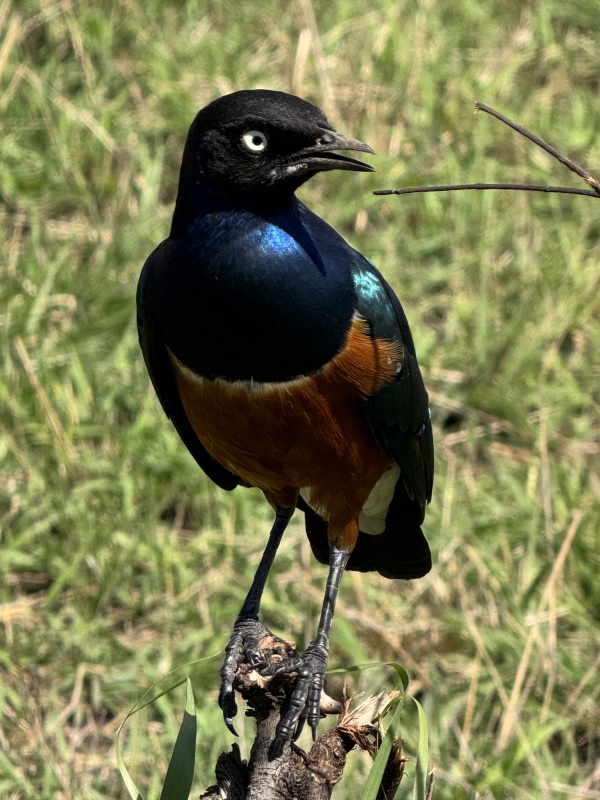
Over time, I began to realise there were animals around; I just wasn’t experienced enough to spot them, and I was a bit impatient. An occasional antelope came down to the water for a drink. Three hyraxes lived in the tree next to our balcony. A lot of colourful birds landed in the trees just long enough to take a photo. One lunch time, all the birds started making a noise. I tried to record it as it was so noisy. Then, a minute later, I saw an eagle fly out of the tree. I knew animals warn each other of danger, but I didn’t know birds did the same.
One day, we had lunch outside, which looked across a large plain and saw a small herd of elephants walk past.
In the mornings, as I walked to breakfast, I said ‘good morning’ to the unseen hippos, the family of hyraxes, the grazing antelope, and the noisy monkeys.
In this place, you had to be patient to see the animals.
The bucket shower
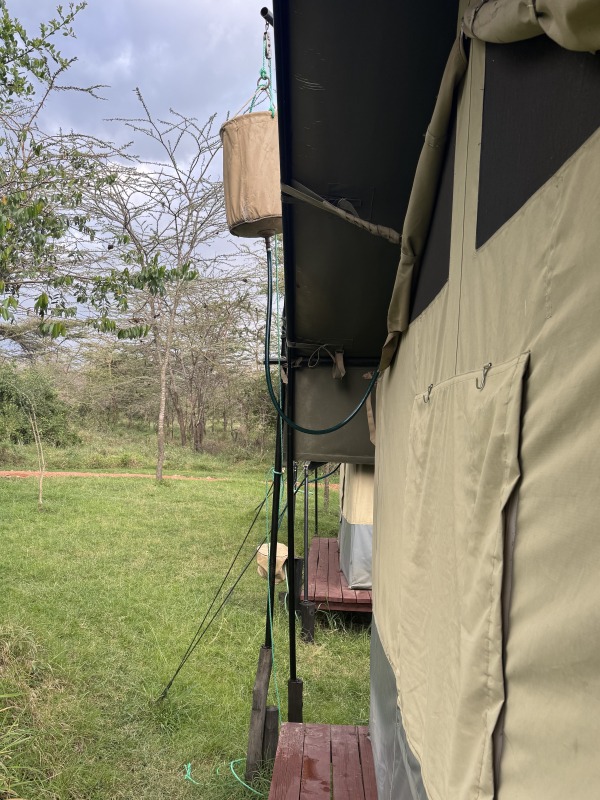
I had never tried a bucket shower before, and it didn’t sound too tricky. A man would fill a container located outside the tent, and then we would enter the shower room and pull one string to activate the water, and the other string to stop the water.
There were two things I learnt from using the shower. One, in winter, it is best to have a shower in the middle of the day when it is warmest.
Secondly, it is not that easy. I thought the difficulty would be having a shower with limited water, but for me, it was finding the string with shampoo running down my face. I find even water makes my eyes sting, so I usually keep my eyes closed while water pours over my head. That wasn’t possible when I was trying to find a string hanging over my head. My husband just held a string in each hand when he had a shower. However, this technique wouldn’t work for me with longer hair. I need a hand to make sure I rinse the shampoo out of my hair properly.
Remember to take a shower as soon as the containers are filled, as it will get cold quickly if you don’t. The best way to use the water is in short bursts. I was worried I would put shampoo in my hair and not have enough water to wash it out, but I had plenty. I usually use shampoo and conditioner, which means two rinses, but I brought a 2-in-1 shampoo and conditioner with me, so I only needed one rinse.
The game drive
In South Africa, our game drives were for several hours early in the morning and again in the late evening. They were at a set time each day. We shared our vehicle with other people. We had one guide driving and talking to us, and a spotter sitting on a seat in front of the jeep. When it got dark, he had a spotlight, which he could shine on interesting things. We found that sometimes, when seated in the back, we couldn’t hear what the guide was saying.
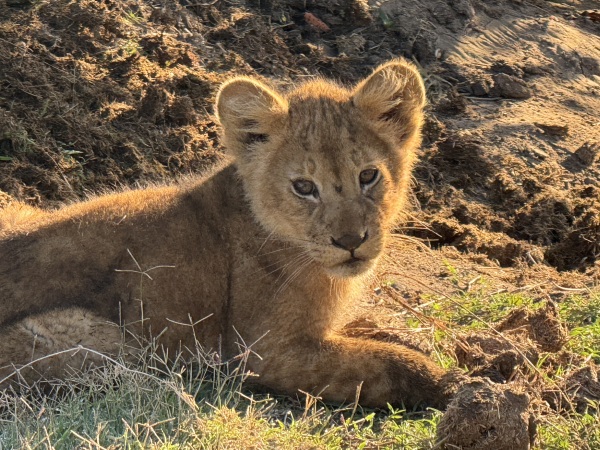
The game drives in Kenya varied in length depending on what we were doing. It was nice that we had the vehicle to ourselves and could swap seats when the interesting animal was on the other side. We didn’t drive after it was dark, but until it got too dark to take good photographs.
The one problem I had was that I needed the bathroom. I found that I couldn’t just pop behind a tree, as I felt too exposed, and then I couldn’t go. On our South African drives, the trips weren’t too long, so I could manage, but in Kenya, our driver kindly found a proper toilet for me on the longer drives. If I were sharing a vehicle with strangers, I don’t think I would have felt comfortable explaining to everyone that even though I had popped behind trees several times. I still need a toilet. One mistake I made was trying to restrict my liquid intake in the morning. Apparently, you can still feel like you need the toilet even if you haven’t drunk much. I found the solution to the problem was to wake up early and have a drink a couple of hours before leaving, then I could cope with a longer drive.
I doubt all game drives in Kenya or South Africa run on similar lines, but it gives you some ideas about what you might prefer.
Multiple camps
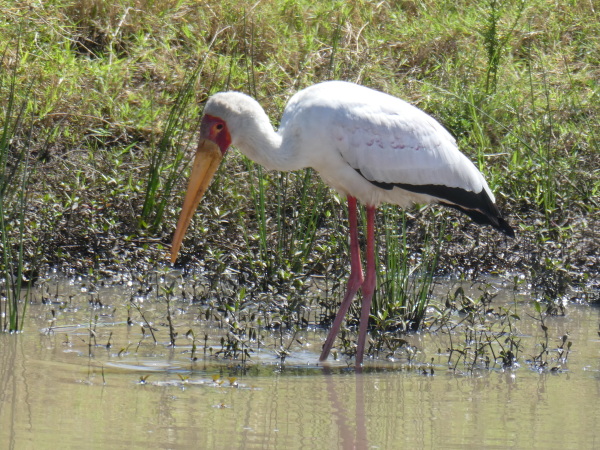
Many people visit multiple camps, staying a few days at each one before moving on to the next, while others travel during the day, stopping at a different camp each night.
Visiting multiple camps gives you the chance to see animals not found elsewhere; however, it can be very tiring, as you travel the whole day, day after day. The roads are often in bad shape or non-existent. After hours of travelling on bad roads, you can feel like every organ in your body needs to be put back in place as you get so shaken up. When we travelled off-road, we encountered huge bumps, we got covered in mud, and our jeep even got stuck in the mud, forcing us to cross a river on foot to reach our rescue vehicle.
I prefer short safaris, as I don’t need to see every elephant in Africa, but if you want to spend two weeks in a region, you will soon become an expert on African animals.
Our walk
We went on a walking safari both in South Africa and Kenya. In South Africa, it was longer and in the middle of a hot afternoon, and we were tracking animals. The guide had a rifle and was in contact with others via a walkie-talkie, which informed him of the locations of the nearby dangerous animals.
In Kenya, the walk was as soon as it got light and was for 2 hours. We were taught about the different footprints, and poop, looked at a kill site and explained what had happened, and learned about the local rocks and plants and how they were used. We felt like we were walking with a detective.
When we first started walking in Kenya, I was a little concerned. Our guide always carried a machete, but the only other weapon was a spear, which we had already examined and could see was blunt. The spear was no longer used as a weapon, but rather as a walking stick or sometimes to dig into the ground or point with.
Just before we left the camp, a security man appeared ahead of us and reported that it was safe for us to start. He then walked out in front, making sure no animals would attack us. I had complete confidence in our safety as the man carried an AK45 machine gun.
The guides in Kenya didn’t need someone else to tell them where the dangerous animals were; they were very attuned to their surroundings. They would watch the animals nearby, and if they looked nervous and stopped eating, our guide knew which direction to steer clear of. Even when we were talking to our guide, he heard a noise and could tell us a lion was a couple of miles away, but we didn’t need to worry.
The Maasai
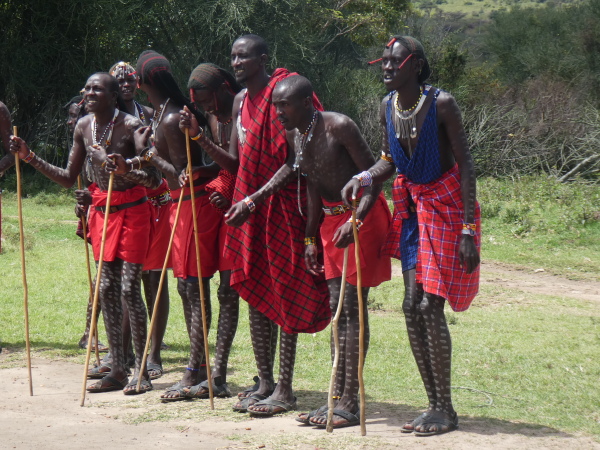
The Maasai are a semi-nomadic group in Kenya, and most, if not all, of the staff were from the Maasai. We were taken to a local village and welcomed with several dances. We had a look around the village and went into a house, where we watched how quickly they could light a fire without matches. We also had the opportunity to meet many children who greeted us.
We, however, learnt much more by chatting to our guides and the staff around our camp.
One guide said he had got into trouble as he suggested the men should only have one wife, and he planned not to take another wife. He reasoned that if he had multiple wives, he would have lots of children to support. He had wanted to be a doctor, but his father couldn’t afford the education. He wanted to be able to pay for his children’s education, so they could then secure better-paid jobs and improve their standard of living. He did, however, still support his uncles, aunts, and other relatives.
Another person thought it was beneficial to have many wives and children, as there would be more people to support him when he was old. This person, however, did tell me that often men couldn’t remember the names of all their children or recognise which was which.
One man had managed to save up a dowry but couldn’t afford a church wedding that he wanted. He said he was lucky as he didn’t have a father and could marry whom he wanted, unlike his friend, whose first wife was his father’s choice.
We learned about their problems with safe medical care, children asking for things their friends have, and losing cattle in a drought being the same as all their savings in the bank disappearing. His children also said he was half-naked when he wore the traditional dress. Apparently, parents can embarrass their children across the world. Somehow, we were being educated, yet it was more like friends just chatting as we do at home.
I felt we learnt a lot more about the local culture in Kenya than in South Africa.
One thing to note is that the Maasai like the colour red. We had been told to wear natural colours when on safari, colours that wouldn’t stand out in the bush. However, I didn’t need to worry about the colours too much as one of our guides always wore red as it is a favourite colour of the Maasai.
Mixing with others
We expected to meet up with other guests at mealtimes and discuss the day; however, we were the only ones in the camp for the first few days. When other guests did arrive, we had little contact with them because we were waking up at different times and either having breakfast out in the bush or very early before a full day’s drive. The camp had a good system to make you feel special and not part of a group.
The cook was excellent and prepared special meals for our daughter, who has a restricted diet. The only problem we had was that, like most cooks, they want to provide you with lots of food. We had 3-course meals at lunch and dinner. On the first day, we had a salad and a large plate of meat. We thought that was our meal, but we were then given two more large courses. When you are in a large group, you can take a small portion or decline some of the food, but when the cook has spent time cooking and preparing meals especially for you, it feels rude to refuse them.
The maximum number of people this camp took was 14.
The time of year
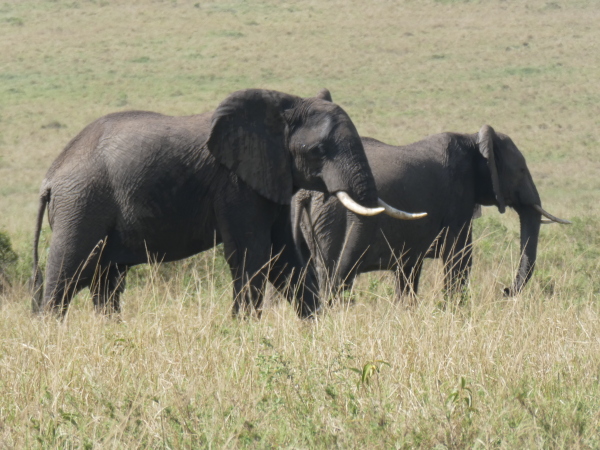
Our Kenya safari was at the same time of year as our previous safari, but being in a tent made a big difference at night when it got cold. Often, we had to get up early for a game drive, hours before the sun started to warm up the day. At nighttime, we didn’t feel as cold. During dinner, a kind staff member put hot water bottles into our beds.
I had brought warm nightclothes with me for this part of our holiday; you might want to do the same.
It was in the morning, as we were getting dressed, that we felt the chill the most.
In Kenya, the best time to witness the migration is from July to October, or during the dry season, from January to February.
In South Africa, from May to October is the dry season, and it is considered the best time for game viewing.
The animals
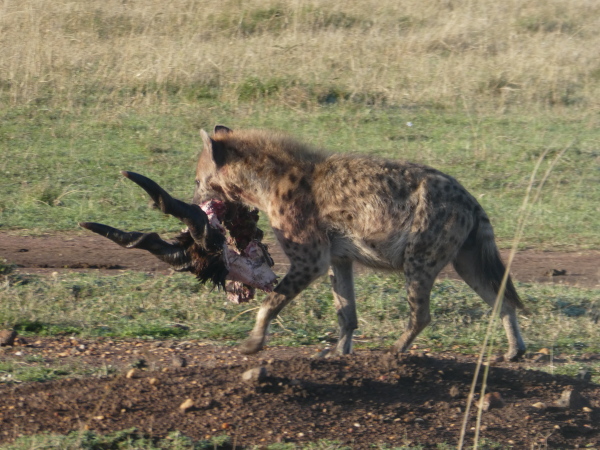
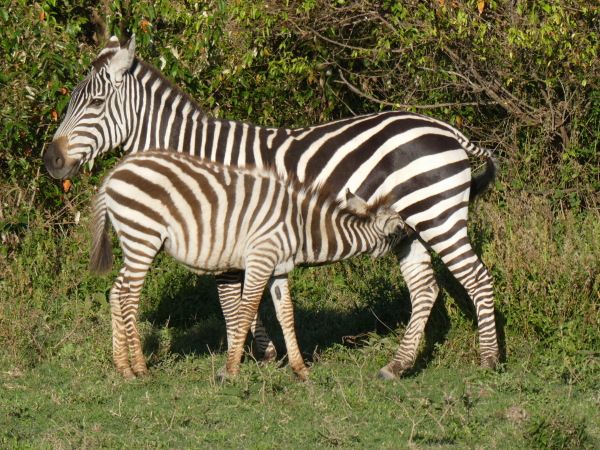
The primary purpose of a safari is to see the animals. We saw a greater variety of species in South Africa, but this is partly due to luck. One time, you might see one of the rare animals, and the following week, no one can find them.
It is possible to see the Big Five in both South Africa and Kenya. The Great Migration in Kenya takes place over an extended period, so the likelihood of witnessing it during your visit is low.
I think the country you go to isn’t as important as where you go in that country. In Kenya, we went on a day trip to the Maasai Mara. This place is open to the public and can get very crowded. There were 40 vehicles crowded around two leopards. The area is large, and it felt more like a race to each animal. Some of the city drivers didn’t appear to be that careful around the animals.
We stayed at a conservancy and had a much better experience there. No other vehicles were trying to get a glimpse of the animals. We saw a lot more animals than in the Maasai Mara, and they were a lot closer. It just felt a lot more animal-friendly and relaxed.
In South Africa, we stayed at a private game reserve that shared the land with the neighbouring reserve. They had an agreement that only one vehicle would be near the animals at a time, and the drivers took turns getting close enough for good photos. We were adjacent to the Kruger National Park, but didn’t feel the need to visit it.
Accessibility and Infrastructure
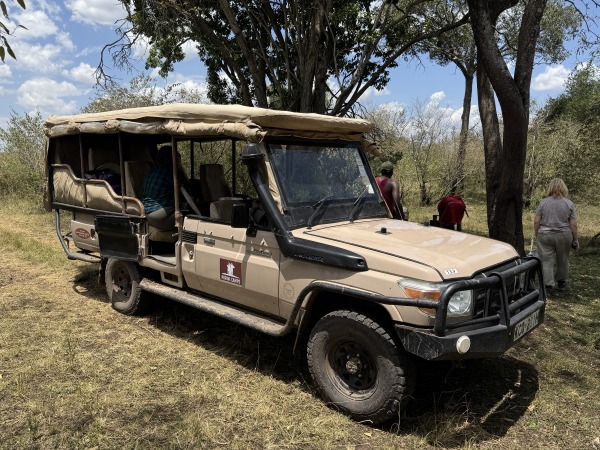
In South Africa, we hired a car but didn’t use it for the safari part of our holiday. Many of the parks are accessible by car, but I would be worried in case we broke down and were unable to get a mobile signal. South Africa has easier access and good infrastructure.
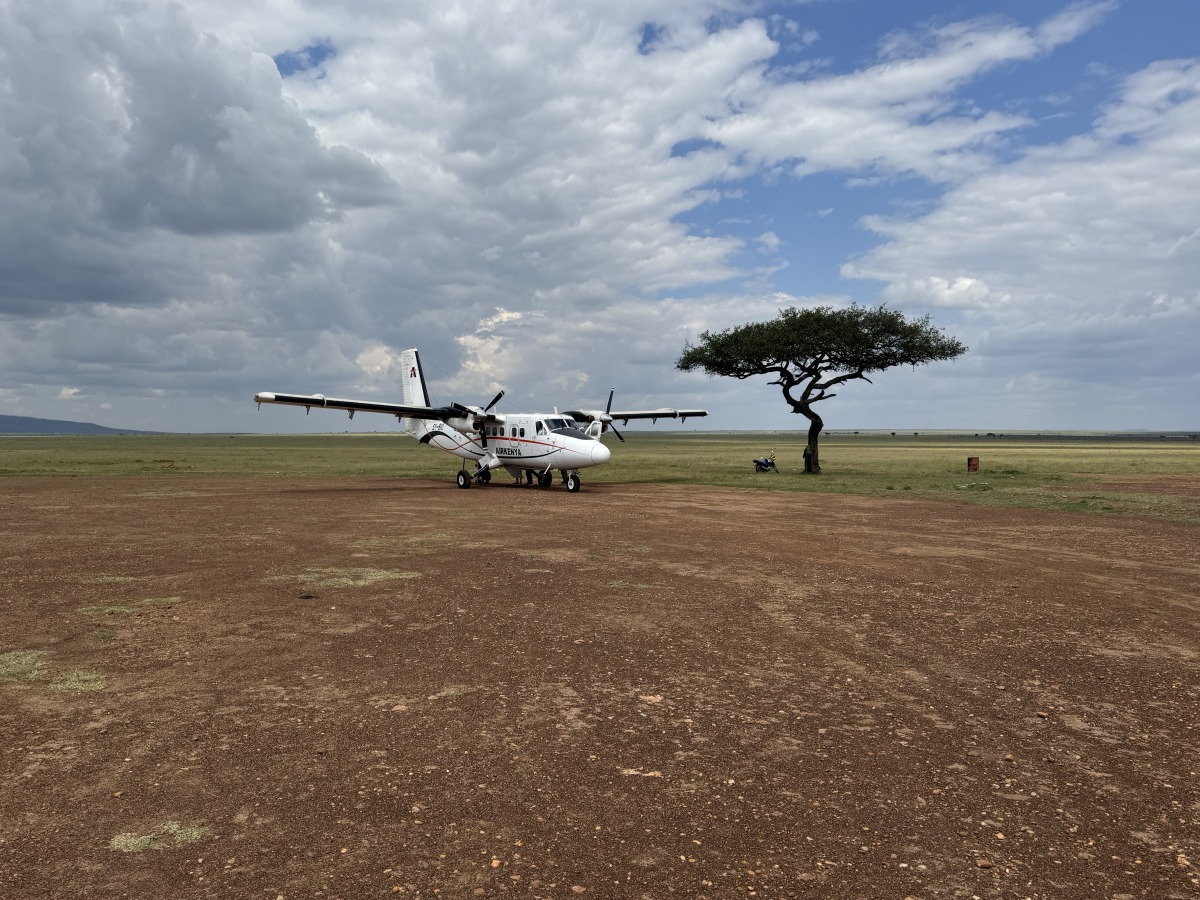
Our Kenya safari was more remote; we had to take two flights to get back to Nairobi. The first fight was in a 20-seater plane, and we had the plane to ourselves and the crew. This plane landed in a field with just a tree marking the airport. The animals scattered as we landed. We really felt we were in the depths of Africa. The second plane was smaller but had other passengers. We felt like explorers as we tossed our bags in the cabin. Choose any empty seat, and the aircraft could now depart as we had arrived.
Summary
South Africa might have been a better experience for a first timer. This was because it felt less remote and had high-end lodges. The staff were professional, and the owner impressed me with his concern over the rest of our trip.
In Kenya, however, we got to know our guides; it felt more friendly, but still professional. The area felt more rugged, and we drove most of the time off-road, so I wouldn’t recommend it to anyone with a bad back. The service was excellent, and the atmosphere was very comfortable.
When choosing where to go, decide on what you want. Do you want to sit where you can see a waterhole and watch the animals when you are not on a game drive? Do you enjoy exchanging stories with other guests? Or would you rather not have to put up with other guests sharing the same vehicle and always hogging the best seat or sticking their super-long lens into everyone’s shots? Do you want a massage at the end of the day and cocktails by the bar, or to sit around a log fire and watch the stars appear? There are numerous options available. I can’t decide which country I prefer because they were both excellent.
A safari is a great experience, whichever country you choose. Good luck with your animal encounters.
Leave a Reply