There was something magical when we visited Peru. For a short time, I wasn’t worried about walking next to a long drop. I presume I found the country so interesting that I forgot to be concerned. Unless there was something strange in the leaves I chewed to overcome the high altitude. There is the mighty Amazon to explore, floating villages on Lake Titicaca, and the highlight of a visit is Machu Picchu. Peru is a country full of archaeological treasures and stunning natural countryside of mountains, forests, deserts, jungles and lakes.
When to go
The best time to visit is May to September, as this is the dry season. November to March is the wet season. During the wet season, it becomes wet and muddy. Occasionally, this can lead to mudslides and close routes. In February 2023, hundreds of tourists were stranded due to landslides near Machu Picchu.
April and October are the shoulder seasons when you can get cheaper hotels and may be lucky with the weather.
The temperature varies widely in the dry season, depending on which region you are travelling to.
In the Andes Highlands, such as Cusco, Machu Picchu and Lake Titicaca. It can be – Day: 15–20°C (59–68°F) Night: 0–5°C (32–41°F).
In the Amazon Rainforest area, such as Iquitos and Puerto Maldonado, it can be – Day: 28–33°C (82–91°F) Night: 20–24°C (68–75°F)
In the Coastal Desert region, which includes Lima, Paracas, and Trujillo.
It can be – Day: 15–20°C (59–68°F) Night: 12–16°C (54–61°F).
Safety
Most holidays are trouble-free, but to ensure you are among the lucky ones, you need to take precautions.
Theft and muggings are common, especially in cities like Lima and Cusco. Don’t walk around with your phone in your hand; if you need to use it, step into a hotel or shop entrance.
Be extra careful at night and avoid areas with few people.
When we were in Lima, I saw three ladies out in the evening who were tourists and had their handbags slung over their shoulders. It was dark, and they were going down a short alleyway to the shops. I, on the other hand, had my belongings in a plastic carry bag I got from the local shop. We all looked like tourists, but the ladies were more obvious targets for thieves as each handbag probably had a purse in it, and we were sticking to the main path. You might not be able to hide the fact that you are a tourist, but at least you can hide your valuables.
Criminals target cars stopped at traffic lights, so keep your doors locked and windows shut while driving.
There are fake taxi drivers who might rob you or take you to an ATM and threaten you unless you make a significant withdrawal. There have been problems with fake taxi drivers at Jorge Chavez International Airport (near Lima). Make sure you use a genuine driver by using an app, asking your hotel to arrange a taxi for you or using official taxi companies at the airports.
In Peru, political protests can quickly turn nasty, so keep away from any demonstrations. During our time in Peru, protests were disrupting train travel.
If you plan to do any adventure activities, check carefully that it is safe. Some people have been killed when using sand buggies.
Hints
- The tap water is not safe to drink.
- You should always carry ID with you.
- There are tourist police available in major tourist cities who often speak English.
- The official currency in Peru is the Sol (currency code PEN).
- You will need cash in rural areas.
- Tipping is customary.
- Yellow fever vaccination is recommended for jungle areas.
- Haggling at markets is normal.
Food and Drink

There are several different foods to try. Ceviche is raw fish marinated in lime juice, and this is probably the most iconic dish in Peru. It is usually made with peppers and onions. There are different variations across Peru. If you are on holiday on 28th June, be sure to try it, as it is National Ceviche Day.
Aji De Gallina is a creamy chicken stew. It is only mildly spiced and served with rice, potatoes and maybe a boiled egg. It is considered a comfort food.
Cuy is guinea pig. We didn’t try this as we have 11 pet guinea pigs at home and couldn’t look them in the eye if we had eaten one of their relatives on holiday.
Papa a la huancaina is a tasty dish made with potatoes in a spicy cheese sauce. It is often served cold or at room temperature. It is usually an appetiser atcelebrations, festivals, and family meals.
Lots of Peruvian food is a mixture of Indigenous Traditions and Spanish cuisine. Lomo saltado, however, is stir-fried beef and has a Chinese influence. Lots of Chinese people came to Peru to work on the railroads and plantations. Lomo Saltado means jumping beef because the meat looks like it is jumping when cooked in a wok.
Pisco Sour is an alcoholic cocktail found everywhere. It is made with a brandy grape, lime juice, syrup, egg white and Angostura bitters.
If you prefer a non-alcoholic drink, you could try Chicha Morada, which is a corn-based drink flavoured with pineapple, cinnamon and cloves. This drink is deep purple or dark violet.
Altitude sickness
Altitude sickness, called soroche in Peru, can be a problem for some people. It affects people when they go to places of high altitude, such as Cusco (3,400 m / 11,155 ft)or Lake Titicaca (3,800 m / 12,500 ft).
Altitude sickness occurs when your body doesn’t get enough oxygen at high elevations, and it needs time to adjust.
Symptoms can appear 6-24 hours after arriving at a high altitude. The symptoms can be a headache, vomiting, dizziness or light-headedness, fatigue, loss of appetite, difficulty sleeping and shortness of breath.
Those who suffer the worst tend to be young, fit men because they push themselves hard and ignore the symptoms.
To prevent altitude sickness, consider spending a night at a lower altitude, such as the Sacred Valley, before heading to Cusco. Drink plenty of water, and eat light meals if you feel sick. The most important thing is to rest on the first day and take it easy. Coca tea is a traditional remedy that can help. At our hotel, there were coca leaves you could chew. The taste was okay, but I didn’t like the texture. I wouldn’t usually put dried leaves in my mouth. Often, hotels will offer coca tea on arrival. Do not take any spare coca leaves home, as in some countries they are illegal.
I had a slight foggy feeling on my first day of arriving, but what surprised me most was that as soon as I arrived at the airport, I found it more difficult to walk up a slope. When we had to walk up a flight of stairs, we had to go slowly. We, however, adjusted very quickly and had no problems after the first day.
Staff at hotels in high-altitude areas are trained to recognise the symptoms of altitude sickness and can assist you. Some hotels have portable oxygen tanks or even oxygen enrichment rooms or oxygen bars.
If you experience chest tightness, trouble breathing at rest, severe headaches, confusion, or difficulty walking, seek medical help immediately, as you could be experiencing High-Altitude Pulmonary Edema or Cerebral oedema (edema). These are severe conditions that require prompt treatment.
If you have a medical condition, you don’t have an increased risk of suffering from altitude sickness, but its effects can be more severe, especially if you have lung or heart problems.
As my husband has asthma, we were pleased he had no problems, but as a precaution, you should carry your inhaler with you even for short walks.
Machu Picchu

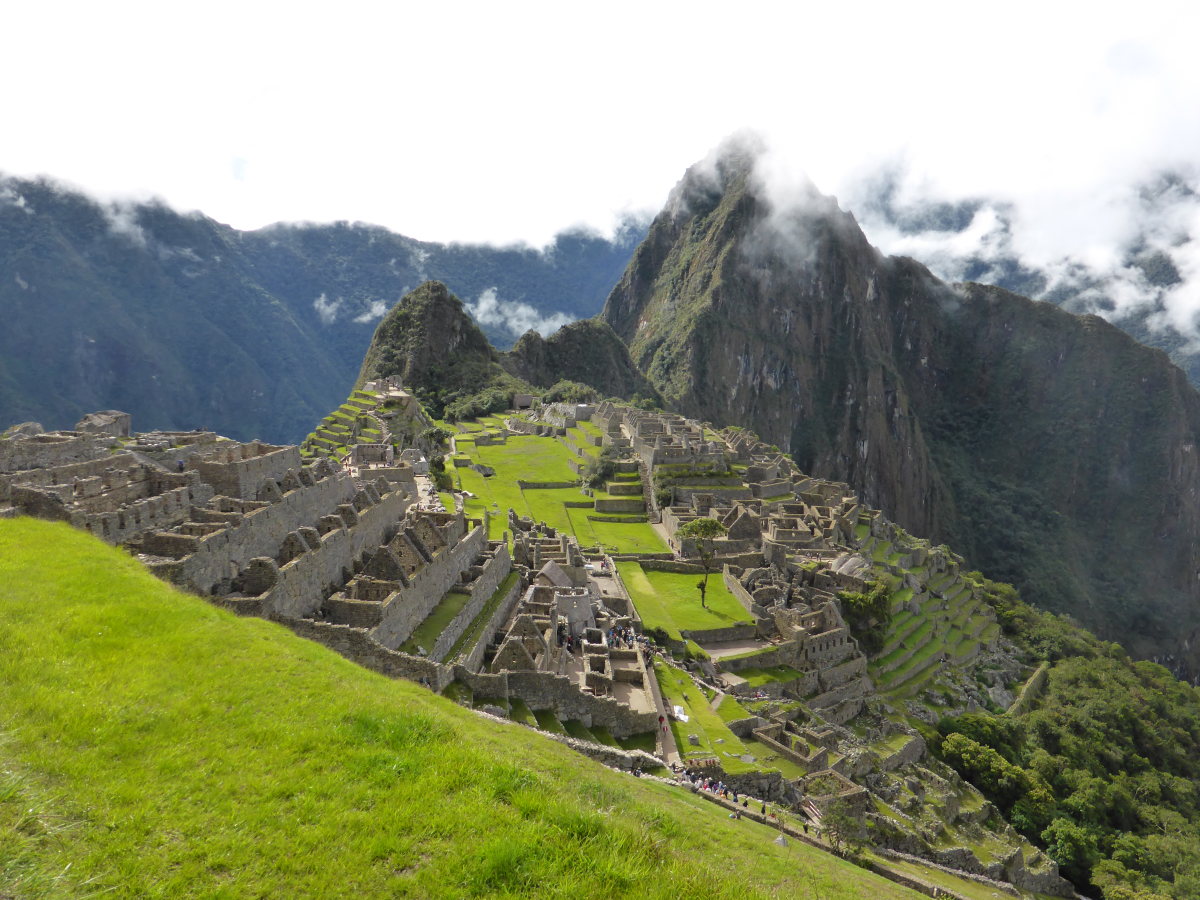
Machu Picchu is one of the New Wonders of the World. It is a very large sacred complex from the 15th century, high up in the Andes Mountains. The Spanish never found it during their conquest, so it remained in good condition compared to other places of that period.
Machu Picchu is on a narrow mountain ridge with steep, jungle-covered peaks and the Huayna Picchu mountain looking down on it. In the early morning, as the mist clears, the magical Incan citadel appears.
There are stone houses, temples, plazas, and terraces used for farming, and the occasional Llama wanders around.
We were here for a couple of days. On the first day, we hired a tour guide who explained and pointed out all the things we would have missed. We later visited on our own and explored the place at leisure.
To get to Machu Picchu, most people fly to Lima and then fly to Cusco.
From Cusco, the easiest way to get to Aguas Calientes, the town at the base of Machu Picchu, is by train. Although you can get a train from Cusco (Poroy station), most people go to Ollantaytambo by taxi or bus and catch a train from there, as there are more frequent services.
We took a taxi, without stopping, it would have taken 1½ to two hours. We stopped on the way to see the Maras salt pans and Moray (circular agricultural terraces), both worth a visit.

We booked the train from Ollantaytambo to Machu Picchu independently, but we encountered numerous problems due to our foreign phone and bank details. After sending them an email, they booked the seats for us, and we were fortunate to secure two seats at the front of the train with a large window in front of us. If we went again, I would use a third party to book the train.
Most people stay at Aguas Calientes and then catch the bus up to Machu Picchu.
We stayed at the Hotel right next to the Machu Picchu entrance. The Sanctuary Lodge, a Belmond Hotel, is very pricey. The service was excellent, but the room we had was nothing special.
However, we couldn’t have got a better location. On our first day, it rained and everyone caught the bus back down. We returned to our hotel and had a lovely meal, watching people get wet as they waited at the bus stop. Then, when the rain stopped, we returned to Machu Picchu, which was nearly empty. The next morning, we were among the first to enter and the last to leave, as everyone except those staying at the hotel had to catch the last bus. We could take our time when it closed, as there was no concern about transport back down to Aguas Calientes.
If you are feeling energetic, you can walk to Machu Picchu. The most famous route is the Inca Trail, which takes 4 days.
Machu Picchu is hugely popular; you need to book tickets in advance. You need to book entrance tickets and train tickets, or if you want to walk the Inca Trail, you need to book a licensed guide. It is a legal requirement to have a licensed guide, and they can be fully booked for months, so arrange things early; sometimes they are booked 6 months in advance.
You can see most of Machu Picchu in one day, but we found plenty to do in two days. Some of the places we explored are no longer accessible to the general public due to overcrowding and conservation concerns. You are also no longer allowed to bring food into the site. So you can’t do what we did and have a picnic with one of the best views in the world. It is still a fantastic place and one you should visit in Peru.
Lima

Lima is the capital of Peru, with colonial charm, pre-Columbian history and a rich cultural legacy. There is plenty to see, and when you’re hungry, you can choose from some of the best restaurants in the world, street food, or local markets.
The San Francisco Monastery and catacombs, a church and monastery of St. Francis, was built in 1674. You aren’t allowed to take photos or videos inside. They do tours in English or Spanish. We were lucky that there were only seven people on the English tour. I found the library fascinating with its circular staircases and wooden panelling. Some of the books are huge, which makes you wonder how they were carried. The catacombs are not suitable for young children. People used to believe you had to be buried in the church to go to heaven; everyone wanted to be buried in the church. They solved the problem by putting the bodies in pits and covering them with lime. Eventually, they stopped because of the health risks. About 25,000 people are believed to be buried there. In recent years, their bones have been sorted out, and you can see the extensive collection of different bones.
If you happen to be near the Presidential Palace (Palacio de Gobierno) near noon, you could watch the guards changing. This is the official residence of the President of Peru.
Circuito Magico Del Agua -This is a mix of fountains, music, lights, and lasers, making it suitable for all age groups. There are 13 different fountains; some feature laser displays, and one is a tunnel that visitors can walk through. Each fountain displays various shapes and plays music. Some are purely visual, while others are interactive, where you try not to get wet. I wasn’t sure about going to this place, but I really enjoyed it. We arranged for a taxi to pick us up and drop us off, but when it finished, it was a bit chaotic as everyone tried to find their driver. Taxis are waiting if you didn’t book one. It is open every evening and the show at the Fantasy Fountain runs 3 times a night.
Huaca Pucllana – this is a pre-Incan archaeological site. It was built around 200 -700 AD and used as an administrative and ceremonial centre. There is also a 25-meter-tall pyramid built to resist earthquakes. They give tours in English and Spanish, which take about 1 hour and are included in the price of the ticket. If you are going during the peak tourist season, it is better to book the tour in advance. There isn’t much shade, so bring a hat if it is sunny.
Miraflores – This area caters well for tourists, it is one of the safest areas and has plenty of hotels, restaurants, shops, and bars. It is located along the Pacific Ocean, where you can walk, jog or cycle along the Malecon and see the stunning coastal cliffs.
Barranco is another area to consider for your hotel; it is very laid back and close to Miraflores. While Centro Histórico is close to many attractions, such as Lima Cathedral or Plaza Mayor, it is not a good place to stay the night as it’s not that safe after dark.
Lake Titicaca

Lake Titicaca is situated between Peru and Bolivia. It is the highest navigable lake in the world. It is very pretty with the blue water surrounded by the snow-capped Andes mountains.
For me, the main attraction is visiting the Uros floating Islands. The Uros community live on islands made of reeds, and tourism is an essential income for them. The base of the islands is very thick, and although the reeds do rot eventually, the whole community ensures it is regularly replaced. You can go to the island for day trips or overnight stays.
I didn’t fancy staying overnight as their toilets are basic. Bring your own toilet paper and hand sanitiser. I also didn’t fancy eating fish caught in a lake where toilets are emptying into it. I am just fussy. However, a day trip is enjoyable. You get to see the whole island, learn their way of life and ride on a reed boat. You might prefer to visit the Amantani or Taquile islands, as they are more authentic and feel less like a tourist trap.
Vinicunca Mountain (Rainbow Mountain)
This place is a mountain with different coloured mineral deposits. It depends on the sun as to how many colours you can spot. It takes about 1.5 to 2 hours to walk up the mountain and about 1 hour to walk down. The main problem is the altitude. If you want, you can take a horse or a motorbike ride.
At 5,000 meters (16,400 feet), you must be properly acclimatised for 2-3 days before attempting the climb and drink plenty of water.
The easiest way to get here is to go to Cusco and book a day trip. You will have to get up early.
The Vinicunca Mountains have gained popularity, especially since they appeared on Instagram. It is one of the top ten places to see in Peru.
Amazon Rainforest
If you want to visit the Amazon Rainforest, the main choices are Puerto Maldonado in the South and Iquitos in the north.
You can reach Iquitos by air and then take a river cruise into the National Reserve Pacaya-Samiria. If you wish, you can then take guided treks along the rainforest trails. Don’t forget your mosquito repellent. If you don’t want to take a cruise, you could stay at an eco-lodge.
At Puerto Maldonado, you can explore the Tambopata National Reserve or Lake Sandoval. If adventure interests you, there are tours where you can enjoy kayaking, ziplining or canopy walkways.
Summary

Peru is a captivating country with so much to offer. Looking down at Machu Picchu is impressive, and cruising through the rainforest is something you won’t forget.
It’s a country where you can learn about the culture and mingle with the friendly indigenous communities, or explore its history, such as the Inca Empire or the Spanish conquest.
You can be active and kayak in the jungle, hike up mountains, or sit back and enjoy the stunning scenery.
Peru is the perfect place for new experiences, with its delicious food and drink, and accommodation to suit every budget. It is easy to plan the perfect Peru holiday and return feeling refreshed and with lasting positive memories.
As well as returning with lots of super soft alpaca wool jumpers, we made some fantastic memories. Go and visit – you won’t be able to resist taking hundreds of photos.
Leave a Reply